Leaks & Water
Finding the real water path first — cap, crown, masonry or roof interface — before choosing a repair.
A stain shows up after rain — how do you find where the water actually gets in before repairing anything?
Water is patient and indirect. It can enter at the top of a chimney and appear as a stain several feet away, travel through masonry, or find an opening at the roof line. That is why leak repair starts with detection: identifying a credible water path instead of sealing the nearest visible crack and hoping.
South Florida’s wind-driven rain makes this especially true. The timing of a stain — only in a hard, angled storm, or after every shower — is a clue that helps narrow the source. A coating applied over an unexamined problem may hide the symptom for a while without fixing the opening.
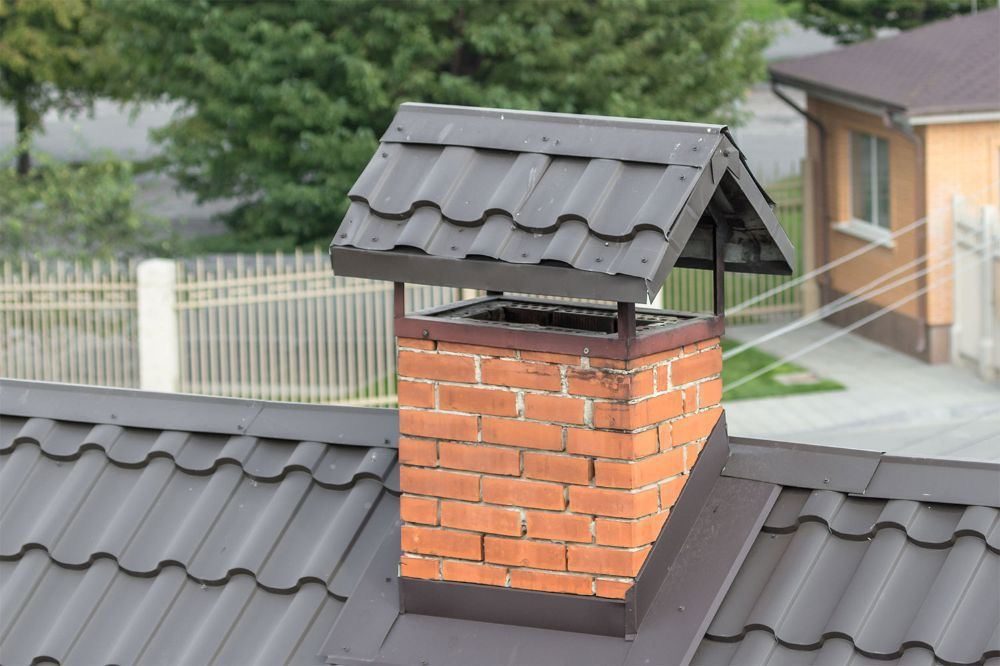
Most chimney leaks come down to a small number of paths, and the job is to tell them apart. The cap and open flue can let rain and debris into the flue. The crown, the top surface of a masonry chimney, can crack and let water into the masonry below. The brick and mortar themselves can absorb or channel water through spalling or worn joints. And the flashing, where the roof meets the chimney, can fail at that joint.
Each path leads to a different repair — cap installation, crown repair, masonry repair or flashing repair. Getting the path right is what makes the repair last.
We start with what can be observed from the ground and from safe access: where the stain begins, whether the firebox itself is wet, and the pattern of recent rain. We avoid the garden-hose test homeowners sometimes try, because uncontrolled spraying can put water where ordinary rain never reaches and confuse the diagnosis.
Where the cause is not visible, an inspection — including a camera look at the concealed flue when warranted — checks the surfaces that a ground-level view cannot. The point is a methodical process, not a guess dressed up as certainty.
Applying a general sealer over a cracked crown, a loose joint or a failed flashing tends to trap the problem rather than solve it. Waterproofing has a real role — on sound masonry — but it is not a repair for a defect. If the water is getting in through a broken part, that part has to be addressed first.
A useful question for any leak estimate is: “What is the water doing before it reaches this spot, and how does the proposed work interrupt that path?” A clear answer connects the repair to the route the water takes.
A good leak repair comes with a way to check it. Keep before-and-after photos and watch the area during the next comparable rain. If more than one path was plausible, we say which was addressed and what to watch for, rather than promising a single indoor photo guarantees a permanent fix.
If a fireplace has taken on water, it is also worth a condition check before use, since moisture can affect components that are not visible from the room.
If a leak has been found but the repair is scheduled for later, a few habits limit the damage in the meantime. Keep the fireplace unused if it is taking on water, since moisture can affect components you cannot see. Photograph the stain during each rain so you can tell your technician whether it is getting worse. And avoid the urge to smear sealant over the interior symptom, which hides the evidence a repair depends on.
None of that fixes the leak, but it keeps the situation stable and the diagnosis clear until the real repair can be made.
We don’t quote prices online because the right scope depends on the system. These are the factors that usually move an estimate:
If water is entering near electrical fixtures, causing sagging, or spreading across the ceiling, address the immediate safety concern and contact the appropriate professional right away, and keep the fireplace off until the source is understood.
A short leak log saves time:
Because it often isn’t. Flashing is one of four common paths, and a wet upper chimney can send water downward past it. Naming the source without checking risks repairing the wrong thing.
We don’t recommend it. Uncontrolled spraying can reach places ordinary rain would not and make the diagnosis harder. Let the investigation be methodical.
No. Waterproofing protects sound masonry from absorption. It does not bridge a crack or replace a failed component.
Yes. Wind-driven rain reaches details that a light, straight-down shower does not. That timing helps point us toward the likely path.
Talk to a technician
You don’t need to know the name of every chimney part. Tell us what you notice, whether the system burns wood or gas, and your ZIP code. If a system shows signs it may be unsafe to use, stop using it until it has been evaluated.
Available 24/7 954-408-2734
